

Every week, HR, People Ops and recruiting folks post questions in PeoplePeople, our free Slack community of 11,000+ practitioners. Some come with a deadline. Some are awkward enough that you'd never ask your CEO. Most are the kind of thing you can't Google, because the answer depends on someone who has already done it.
We went through every substantive question posted from mid-August to mid-October 2026. Most got an answer from a peer, and the busiest thread ran well past a dozen replies. Then we compared them with what the wider HR world was publishing over the same stretch: news, research, legal updates and the usual LinkedIn churn.
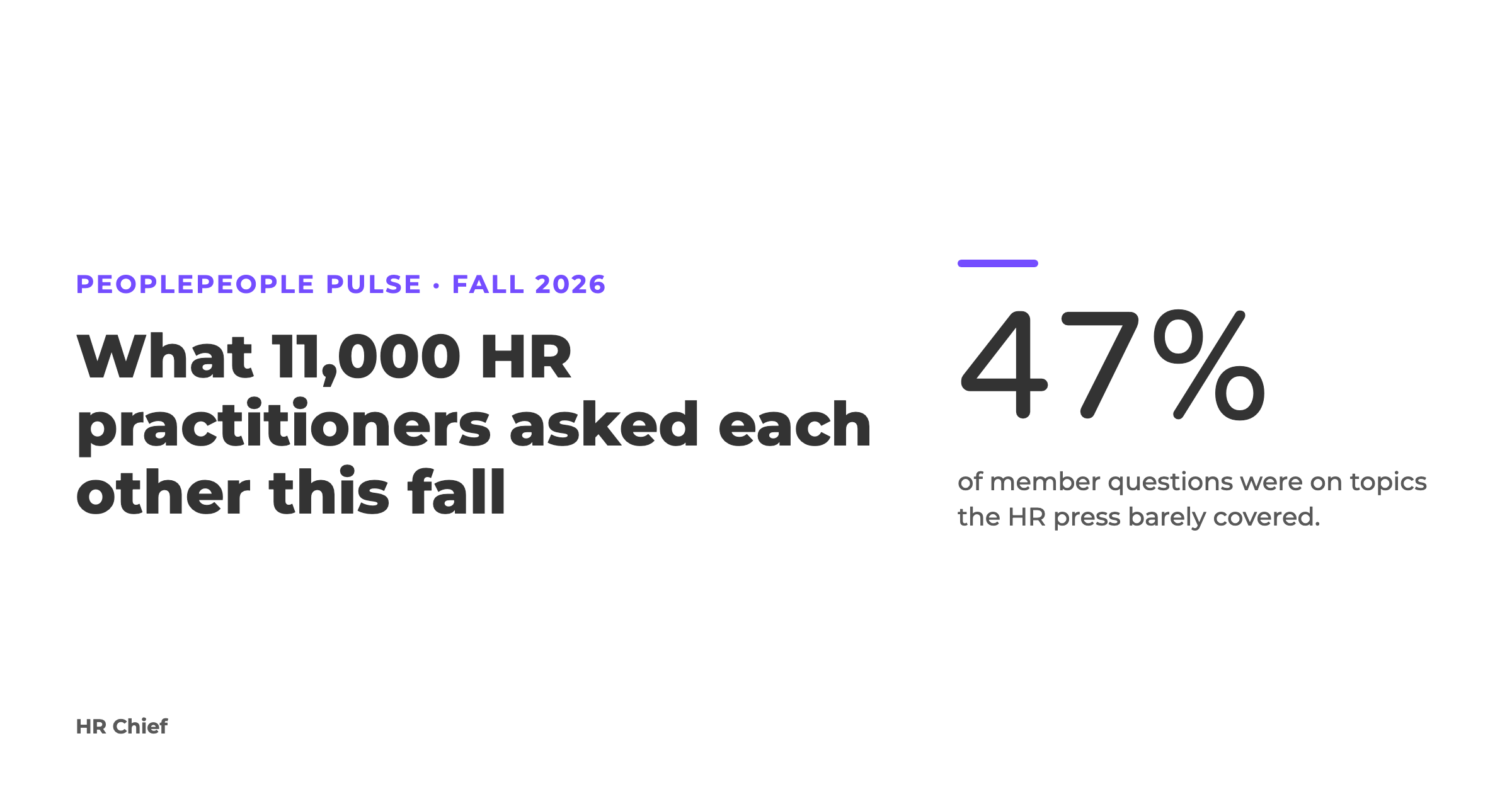
The short version: the headlines are about big pressures like costs, jobs data and regulation. The community is about making things work on a Tuesday afternoon. Almost half of what members asked about got little or no coverage in the HR press.

Recruiters in the community asked how to keep shortlisted candidates warm while waiting on a favorite. The consensus was to name a "1A" finalist, keep them engaged, don't send rejections until the offer is signed, and give full feedback either way.
Outside, the market looks tight from the employer side too. The US added just 29,000 jobs in September, well below expectations, and unemployment rose to 4.2%. At the same time, 92% of recruiting leaders in a Criteria and Lighthouse Research study cited by Deel say AI-generated resumes are now commonplace. More noise in the pipeline makes the runner-up you already trust more valuable. Treat them well.
The longest thread of the period asked what happens after the first 30 days of a change rollout. Does the new behavior stick, or fade?
Two answers stood out. One member described moving a whole organization onto a new tool within a few months, with a champion on every team, a channel for questions, regular office hours and shout outs for people using it well. Another argued for deciding how you'll measure adoption before launch, with your data team involved from the start. That way you can coach the people who haven't switched instead of guessing who they are.
The outside world is having the same conversation, mostly about AI. In an Adaptavist survey reported by CIO.com, 42% of knowledge workers said they spend more time checking AI output than it saves them, and 46% said management hasn't addressed their concerns. Sia Partners' 2026 Change Report makes a similar point: companies count rollout activity and rarely measure lasting adoption.
Which salary benchmarking tool should you use now that a popular one has changed its pricing? Members suggested Figures and Ravio for European coverage, and Carta, Radford or Mercer for US tech.
The external data explains the pressure. Payscale puts 2027 salary budgets at 3.5%, and only 32% of companies plan across-the-board raises, down from 36% this year. Pay transparency rules keep spreading too. Connecticut's pay range requirement took effect October 1, and most EU member states were on track to miss the June 7 deadline for the EU Pay Transparency Directive. Translation: raises are getting more targeted, so the benchmark behind each one has to hold up when someone asks why.
Plenty of questions had nothing to do with headlines. Members asked for ideas for a virtual volunteer day that helps a fully remote team feel connected, holiday team building for a hybrid company, and platforms that let employees choose where company donations go.
Then there are the conversations nobody trains you for. One member asked how to handle a hygiene complaint between two officemates without embarrassing anyone. The replies suggested a gentle company-wide reminder as a first step, plus scripts for a kind, direct conversation if that doesn't work. The press mostly skips these. They keep coming up anyway.
A steady stream of questions came from people running HR across borders: an EOR recommendation for a 130-person company, benefits software for a global team, and a playbook for getting home-office equipment back from leavers in Ireland and Spain. Outside of vendor content, this barely made the news. Inside the community, the answers came from experience, like a People Ops lead who shared what their team learned from evaluating more than five EOR vendors before renewing.
One of these comes with a date attached. The UK's Employment Rights Act 2025 makes employers liable for harassment of their staff by customers, clients and contractors unless they took "all reasonable steps" to prevent it. It's expected to apply from October 30, 2026, although as of October 1 the commencement order hadn't been published, and the regulations defining "all reasonable steps" aren't expected until 2027 or later. If you employ anyone in the UK, check that your harassment policy, training and reporting routes cover customers and contractors as well as colleagues, and document what you did and why.
The biggest external story of the period barely came up inside the community. Marsh (the former Mercer survey) projects US health benefit costs per employee will rise 8.2% in 2027, the highest increase since 2003, and 59% of employers plan cost-cutting changes. Business Group on Health puts the median trend at 9.2%, with 14% of employers dropping or planning to drop GLP-1 coverage. Inside the community, US health costs came up early in the period, with one member asking for creative ways to structure medical contributions at companies with fewer than 100 employees. We expect a lot more of that as renewals land and open enrollment starts.
Other big external themes didn't show up at all. Federal rule changes include the EEOC rescinding guidance, a proposal to eliminate EEO-1 reporting and a proposed independent contractor rule. Liability for AI hiring tools is another. In June, a federal judge let several claims in Mobley v. Workday, the AI screening bias case, go forward.
Our read is that many members run HR day to day at small and mid-sized companies. For them, a federal rulemaking is next year's problem and an offer letter is this month's. Both matter. Only one of them lands in your inbox with a signature line.
A few questions from this period are still waiting for a first answer: how to prepare for the UK third-party harassment rules, which benefits software works for a global team, and ideas for a virtual volunteer day that helps a fully remote team feel connected.
If you've been there, the community could use you. PeoplePeople is a free, application-only Slack community for HR, People Ops and Recruiting professionals. Join here.