
Your people don't want more measurement. They want to be seen.
Everything here shows what goes together, not what causes what. Trust the order of things more than the exact percentages.
"I bent over backwards to save a failing project, working 16 hour days for a month straight (weekends included). I left the project with all numbers in the green and wasn't recognized for it / it was completely taken for granted. Once I rolled off and reinforcements came in the numbers tanked and still no credit was given to me for what I had done."
Employee survey respondent, on a time they should have been recognized
Every number on that project was green. Nobody noticed the person behind them.
Most of what we found is some version of that story. People don't want more measurement. They want to be seen.
We asked employees across the US about their work this summer. What went along with engagement was mostly human: room to grow, being heard, belonging, and recognition that's recent and specific. Workplace tech sat near the bottom.

We use Gallup's three labels because most HR teams already think in them. Gallup puts US engagement at 31% (2025). Ours runs higher because our questions and our survey panel are both more generous, so read 47% as this study's starting line, not as a score to beat.
What to do with this
77% are satisfied with their chances to learn and grow
57% vs 16% are engaged: people satisfied with their growth vs people who aren't
Out of 40 things we asked about, room to learn and grow tracked engagement most closely. The top of the list was all human: growth, being heard, useful feedback, belonging. Workplace tech sat near the bottom. Most people (88%) already say their tech helps more than it slows them down, so there's little left to win there. Tools matter, but they aren't where engagement comes from.
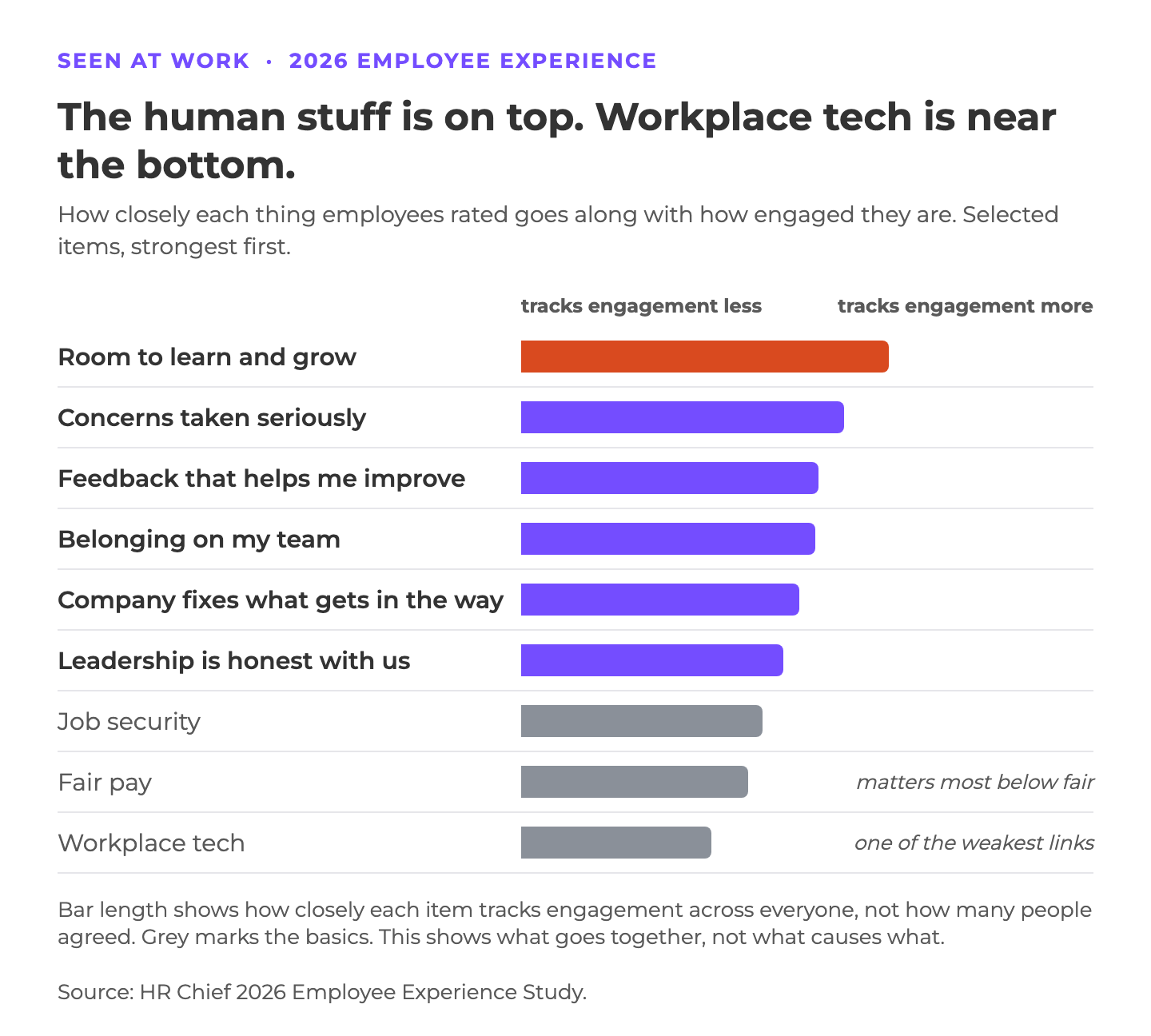
Growth looks different in different jobs: a path to the next title in an office, an apprenticeship or steadier hours on a production floor. It doesn't need a promotion, either. In a hiring freeze it can be a stretch project, a new skill or a move sideways.
"I would like to know I have a clear path to promotion to a higher rank in our company. I feel like I am stuck in the role I am in right now."
Employee survey respondent, on what would most improve their engagement
Good to know: For newer employees, "My onboarding gave me what I needed to do my job well" also tracked engagement closely. Few people answered it, so treat it as a signal. The first unanswered signal is often the new hire nobody checked on in week one.
What to do with this
You can't answer everything. At HRUnite! 2026 we called this filter the Loop Test. Up the side: does it track engagement? Across the bottom: does someone own it, and can they change it?
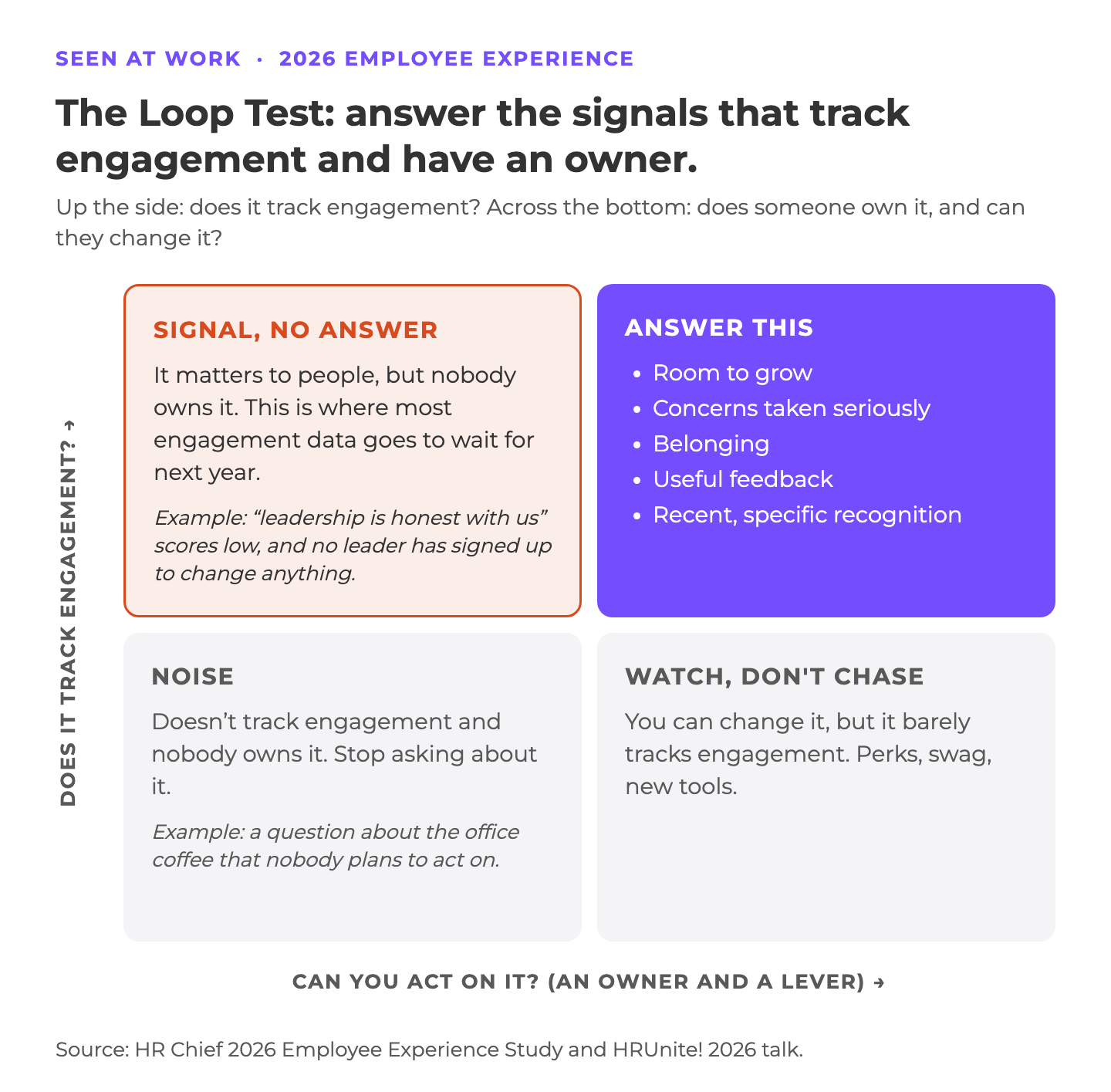
The trap is the top-left: things people care about that nobody owns.
74% say concerns they raise at work are taken seriously
58% vs 18% are engaged: people who feel heard vs people who don't
Being heard and having problems fixed travel together, too. People don't separate "you listened" from "you did something."
The person with the 16-hour days was asked what would most improve their engagement:
"An increase in my manager's engagement with me. He's very removed and doesn't really appreciate the degree to which my work matters"
Employee survey respondent, same person as the opening story
People recognized this week were among the most engaged. People who couldn't remember their last recognition were the least.

Good to know: The drop isn't smooth from week to week. The clear gap is between people recognized in the last week and people who can't remember the last time.
Recognition that lands names the actual work. "Great job, team" says nobody in particular saw anything in particular. About a quarter of the recognition stories people told us mentioned praise that was specific or public. Another 16 were about effort nobody noticed, like the one that opens this report.
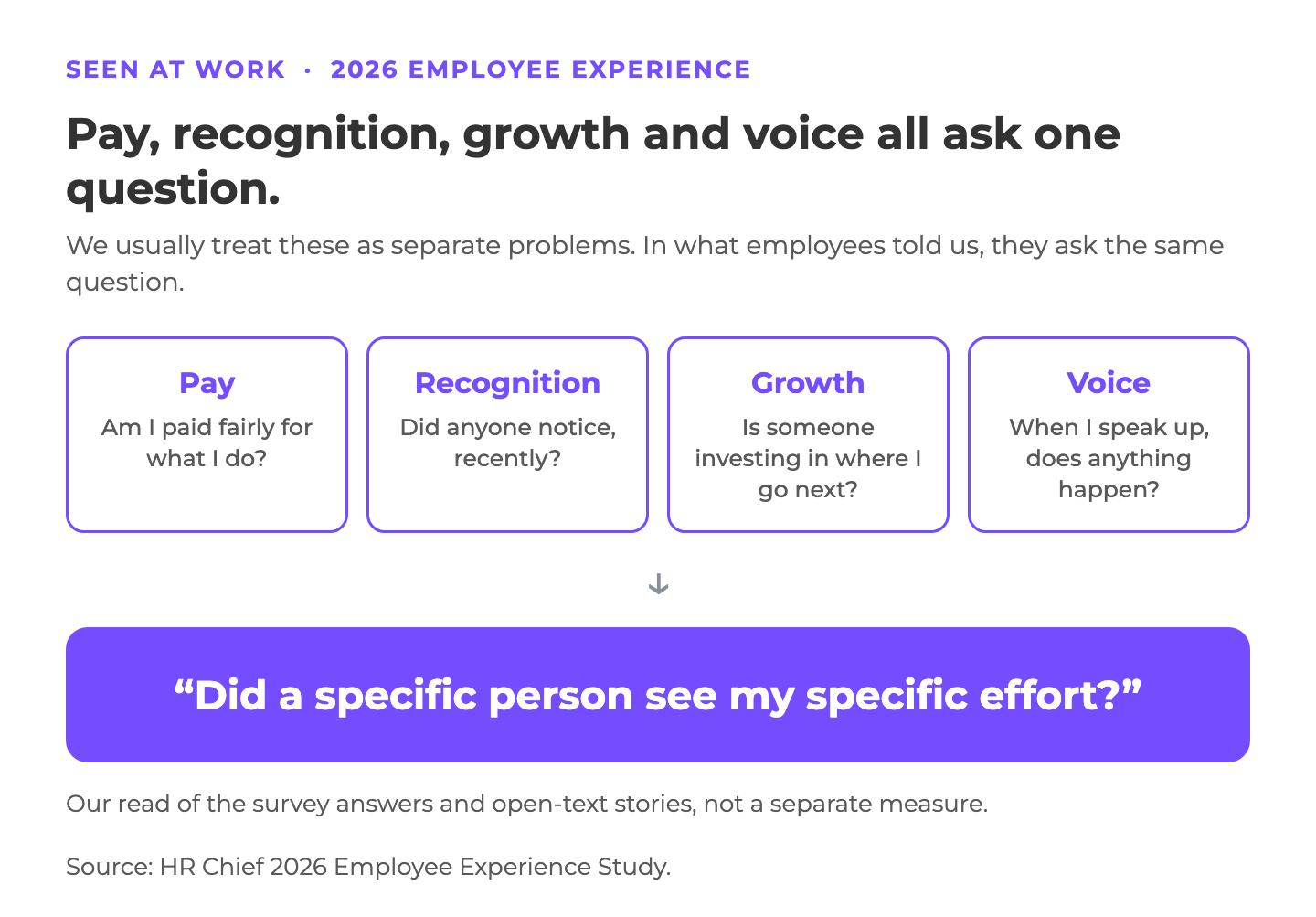
Most companies run these as four programs with four budgets. To employees, they're one question.
What to do with this
57% vs 19% are engaged: people who feel fairly paid vs people who don't
75% agree they're paid fairly. Below fair, pay matters a lot. But its overall link to engagement is modest. Take two people who feel the same about their growth. The one who feels better paid is barely more engaged. Now take two people who feel the same about pay. The one with more room to grow is clearly more engaged. So get pay to fair first, then build.

For some people, pay is the whole story:
"the low, unlivable wage is the only reason I would leave this otherwise fulfilling and wonderful job"
Employee survey respondent, on what would most improve their engagement
Good to know: We measured engagement, not who leaves. For keeping people, pay may matter more. And what counts as fair changes every year, so check it every year.
82% feel secure in their job right now
40% worry their job won't exist a year from now
Both can be true for the same person: 28% said yes to both. Most people aren't panicking, but plenty are paying close attention. If your company has made cuts or frozen hiring, say what you know and what you don't. Silence fills with the worst guess.
What to do with this
Hybrid employees were the most engaged and fully remote the least, but the gap is small and it's the least certain result here. On belonging, 94% of hybrid employees feel they belong on their team, vs 79% of remote employees. Frontline workers were lowest, at 73%: the number to watch if you run a plant, a store or a hospital floor. This is not an argument for return-to-office.
What to do with this
61% say leadership or their manager decided to bring AI into their work
13% chose it themselves
The rollout mostly landed. 69% of employees who use AI at work say their company has been clear about how to use it. The worry is real, though: 40% worry AI could reduce the value of their skills or role. Those people were just as engaged as everyone else.

What to do with this
HR pros see the same top-down pattern from their side. More in The Answer Gap and in our article on AI and unwritten rules.
Go back to the person who saved the failing project. Sixteen-hour days, every number green, "completely taken for granted." Their company had all the data it needed. Nobody answered.
Several of the strongest links in this study cost attention more than money. Your people don't want a survey. They want an answer.
Run this in your org. Our free template has the five engagement questions from this study, four that show where to look, a one-question pulse, and a Decision Card to give one finding one owner and one date. Get the template
Who answered. 215 employed adults (210 in the US) who answered a paid online survey in June 2026. About 3 in 10 work in tech; the rest span retail, healthcare, finance, education, manufacturing and more, at companies from under 50 people to over 20,000.
How we measured engagement. Five statements about energy, enthusiasm, pride, focus and meaning at work, each rated 1 to 7. Engaged means choosing Agree or Strongly agree on at least four, and disagreeing with none. Actively disengaged means an average below 4. The HR Chief Engagement Index turns the five into a 0 to 100 score; the 2026 baseline is 74.
Reading the numbers. A percentage for the whole group could be about 7 points higher or lower in a different 215 people. Smaller groups can move more. We flag groups under 30 and don't show groups under 10. Everything shows what goes together, not what causes what.
HR Chief is an independent media brand for HR and talent acquisition practitioners, with a newsletter, a job board and the PeoplePeople community. For the HR side of this story, read The Answer Gap.
HR Chief. (2026). Seen at Work: The 2026 Employee Experience Report. hrchief.com/research/employee-experience-report-2026