
Can you name one thing that changed because of your last engagement survey? Most HR pros can't.
HR has more data on its people than ever. Most of the HR and People Ops pros we asked still couldn't name one change that came from it. This report is about what comes after the survey: the answer. (It's usually not a budget problem.) Your people don't want a survey. They want an answer.

HR teams aren't short on listening: 71% use manager 1:1s and 48% run an annual engagement survey. The trouble starts after the results come in. Survey fatigue is mostly answer fatigue: people stop filling it in when nothing comes back.
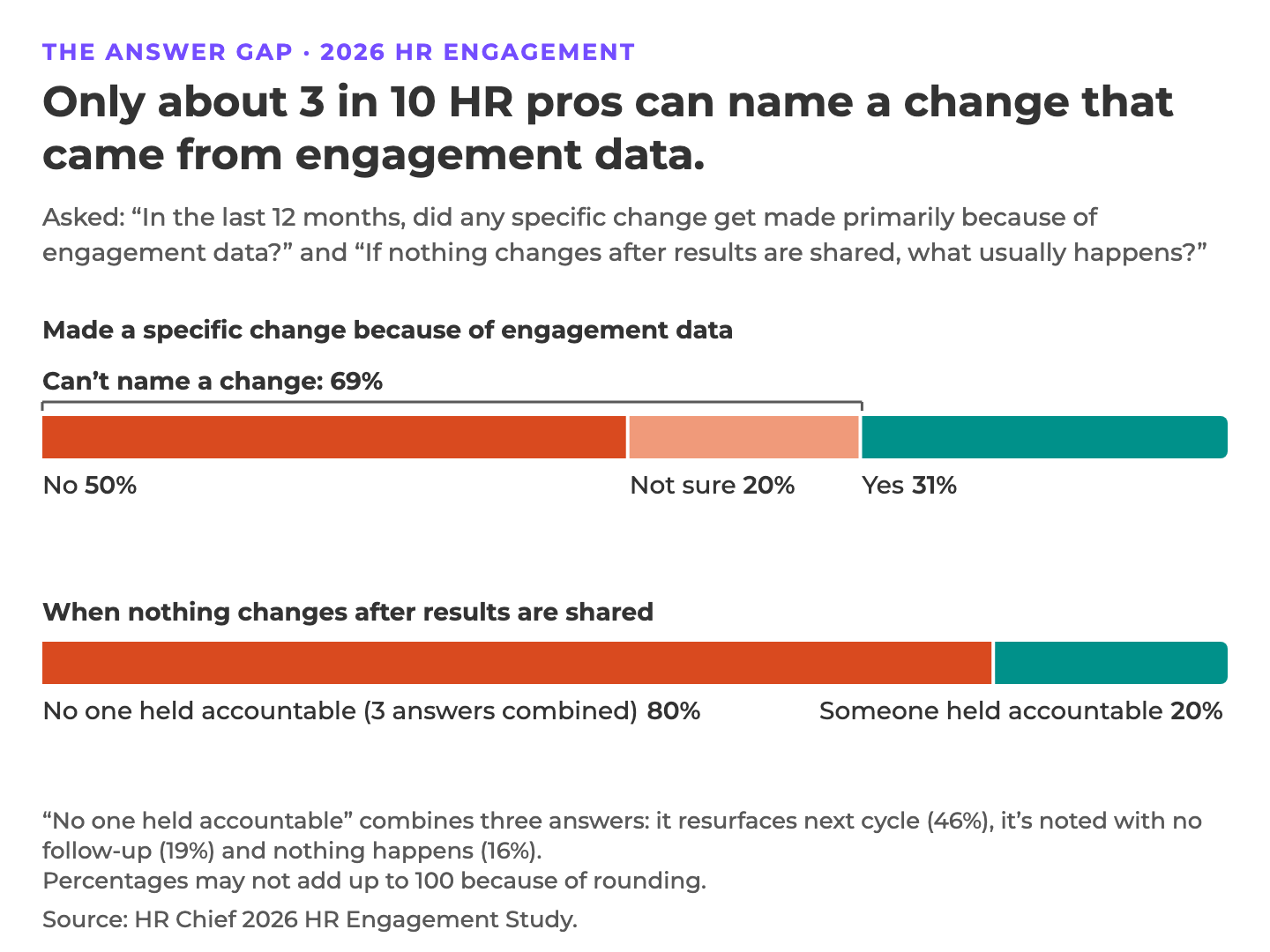
43% have no clear owner for acting on engagement data
41% have never tied a retention or performance result to acting on engagement data
One HR pro put it plainly:
"The hardest part about engagement is that we collect the data and get some interesting insights but then don’t really do anything with it aside from managers sharing results with their teams. There’s no true accountability for action but that’s also by design. We need to continue thinking outside the box on the purpose of surveys and collecting employee sentiment."
HR survey respondent
A former Head of HR at an HR software company, now a fractional HR leader, gave us the rule: "Don't ask questions for things we're not going to do anything about."
What to do with this
59% name competing priorities or leadership attention as the biggest blocker
8% name budget

That's good news, sort of. You can't conjure a budget line, but you can ask for ten minutes in a meeting. Only 7% called missing ownership the biggest blocker, even though 43% have no owner. A busy calendar is easier to see than a missing name.
An answer doesn't have to be big. An answer is a name and a date: someone owns the response, and there's a day it's due. You have the data and none of the authority, so don't try to fix the org. Pick one signal, one team, one owner and one date. Win once, then use that win to earn the next one.
The people doing this work are stretched. 75% say they're being asked to do more with fewer resources, and burnout is the challenge they named most.
"We have had significant cuts this year - nearly 20% of the company has been cut. My own team has reduced from 7 to2 - it's only me (VP) and a recruiter. I'm asked to do more with so much less. It feels like for tech companies, the current hypothesis among CEOs is that all you need is 1 HR person and AI to run a department."
VP of HR, survey respondent
What to do with this
When HR pros need to know how people are really doing, most don't open the survey report. They go to a trusted manager, walk the floor, or ask a long-tenured employee. On remote teams, the hallway is Slack DMs and 1:1s.

That isn't a failure. People tell a trusted manager things they won't put in a form. But if HR trusts the hallway more than the survey, survey results carry less weight where decisions get made.
What to do with this
54% say senior leaders model engagement "sometimes" or less
46% say "often" or "consistently"
HR pros who feel hopeful about the year ahead are far more likely to say their leaders go first. Among optimists, 67% say their leaders model engagement often or consistently. Among pessimists, it's 2 out of 23.
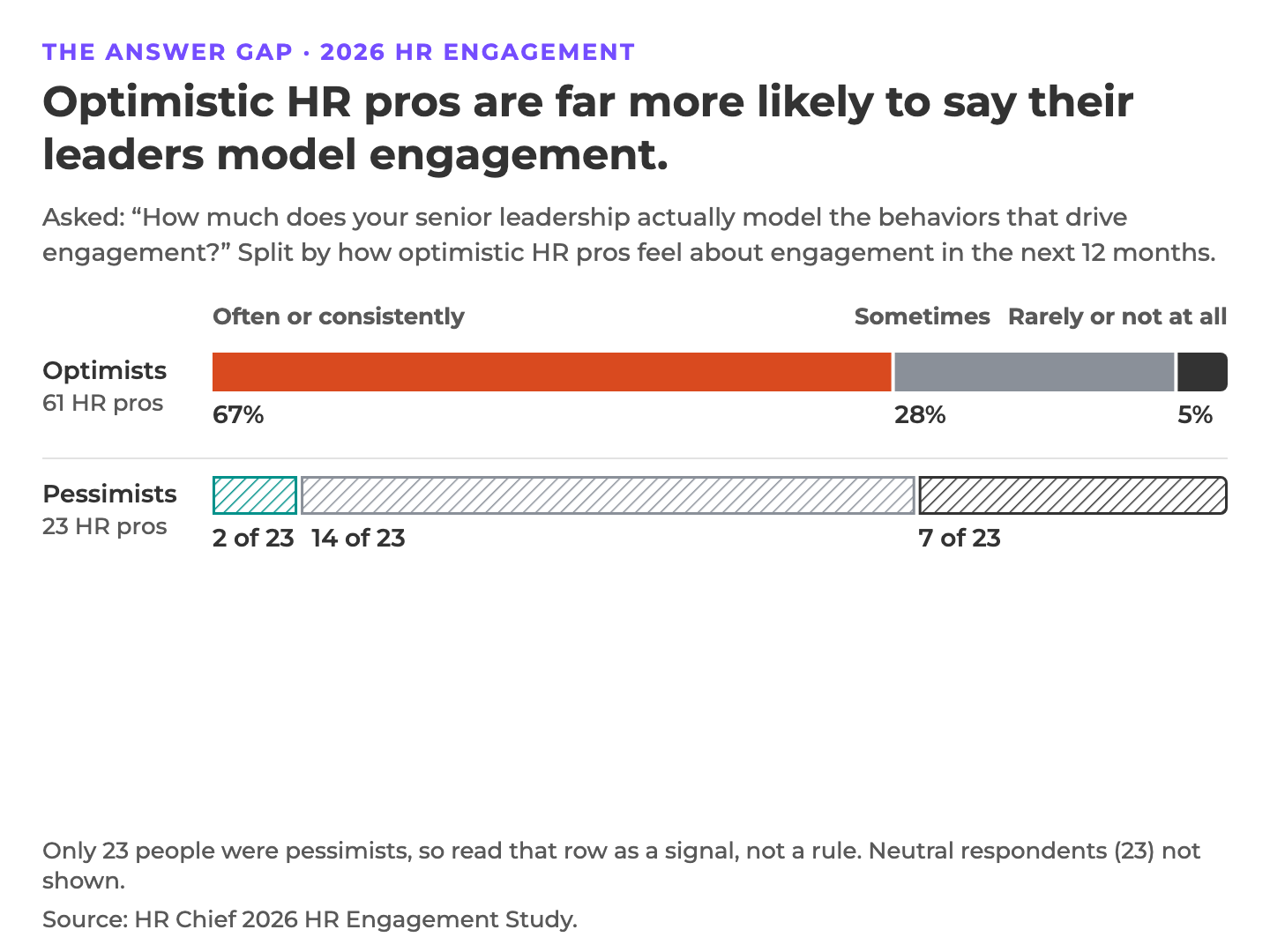
Good to know: This shows the two go together, not that one causes the other. Hopeful people may simply rate their leaders more kindly.
"Engagement is a company problem, which often lands on the People team. We can help diagnose, but without leadership, people managers, and employees taking accountability for it, it's really hard to enact change. I've found a lot of people are waiting for the leadership team to do something to improve engagement, without also being a part of the solution."
HR survey respondent
Your job is to make going first easy for leaders.
What to do with this
68% of HR pros say leadership is pushing for AI in engagement work or would back it. Only 32% work somewhere with a formal, written AI policy for HR.
Before any AI touches engagement work, ask two questions. Does a human still own the judgment? Is the signal real? Operational means scheduling, reminders, first drafts and summaries. Judgment means anything that decides what an employee meant or what happens to them.
Here's what happens when the answer to both is no:
"an automated sentiment tool completely misinterpretid some frustrated nursing feedback about staffing as high engagmenet because they used passionate langage. staff noticed the tone deaf response immediately and called out that a computer must have read it."
HR survey respondent (spelling as written)
The staff caught it. Nobody reviewed the output before it reached them, and that's the step to add. A policy alone isn't the fix: HR pros whose companies have a written policy are mostly the ones already using AI (85% vs 23% with no policy), and they reported more AI problems, not fewer.

For their own recognition, HR pros are clear:
74% would rather get recognition that's genuine, even if it's rare and a bit clumsy
6% would pick frequent, AI-assisted recognition
If a tool drafts the recognition, a person rewrites it before it goes out.
Three sentences for your CEO
What to do with this
Employees see the same top-down pattern from their side. More in Seen at Work and in our article on AI and unwritten rules.
The answer usually isn't HR's to give. It comes from:
What if the signal is "pay's unfair" and there's no money this year? You still answer: "We heard you. Here's what we can do, here's what we can't, and here's why." People can take a no. Silence is the only wrong answer.
Here's the Decision Card, with a filled-in example on each line:
Small company? The owner can be you. The follow-up should still be someone above you.
Run this in your org. Get the engagement questions, the pulse question and a printable Decision Card in our free template. Run this in your org
Who answered. 107 HR and People Ops professionals, surveyed in June 2026. About a third are HR directors, VPs or CHROs; most of the rest work in People Ops or as HR business partners. Almost half work at companies of 200 or fewer people. A few responses came from people in HR-adjacent roles; removing them moved no headline number by more than about 3 points.
Reading the numbers. Percentages are of all 107 unless we say otherwise. Any result could be several points higher or lower in a different group: 31% could land anywhere from about 23% to 40%. Groups under 30 are shown as counts. Comparisons show what goes together, not what causes what. Survey quotes are exact, typos included; interviewees are named by title only.
HR Chief is an independent media brand for HR and talent acquisition practitioners, with a newsletter, a job board and the PeoplePeople community. For the employee side of this story, read Seen at Work.
HR Chief. (2026). The Answer Gap: The 2026 HR Engagement Report. hrchief.com/research/hr-engagement-report-2026